Core Culture is where it all begins
Core Culture: it is your organization’s central principles and values. Those values matter.
According to the LinkedIn Workforce Confidence survey, “82% of U.S. professionals agree with the statement: It is important that I work for a company in which the culture and values are aligned with my own.”
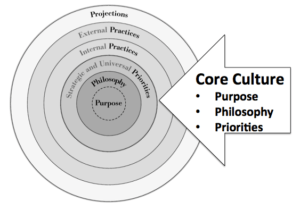 To understand your company’s culture and values, begin at the center. To clarify, dig deep into the organization’s culture. Go to the core. There you will find the core principles and values that guide the business. To sum up, this is the essence of the organization’s culture.
Every organization must have a clearly defined Core Culture. If it is not defined and shared, then employee Practices may not consistently be aligned with those principles.
In addition, if the organization must undergo change, the change must be integrated into the Core Culture.
Core Culture = Purpose + Philosophy + Priorities
The formula is simple. To clarify, Core Culture consists of the Purpose, Philosophy, and Priorities. These are the central three Ps–of the Five Ps–of an organization.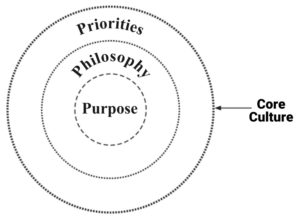
- It consists of the vital Purpose. Purpose is why the organization exists.
- Add to that, the distinctive and relatively enduring Philosophy. These principles and values are typically a reflection of the founder or the spirit and ideals that were part of the organization’s creation.
- And, in addition, are the Priorities. Priorities are values that may change over time. To clarify, they are what the organization needs to focus on and pay attention to in the current environment to be successful and to thrive.
As a unit, these principles and values form the foundation for why the organization is in business. And they provide the framework for how employees should conduct that business.
Be sure employees know these core principles and values
In successful organizations, you have a clearly defined Core Culture. And it is shared. Above all, it guides the behavior of employees as they interact with each other. Likewise, it guides employees as they interact with others outside the organization. Employees must know and live by this small set of guiding principles and values.
An organization stands for something. It has a character that is core to its soul. Achieving greatness begins with employees understanding the organization’s contribution and character and its path to success. These principles and values are its Core Culture.
Whatever you call it does not matter. What matters is whether or not you can define it. And, most importantly, whether employees live by these principles. Most of all, don’t let culture be a cloud that no one can easily share and practice.
Conduct a culture assessment
Conduct a culture assessment to define your core principles and values. Firstly, you must define the unique essence of your organization. This essence is its identity. It consists of the Purpose and the Philosophy.
Next, to be strategic and build employee engagement, in addition, identify the strategic and universal Priorities to focus on and pay attention to. Strategic Priorities link strategy to the core. Universal Priorities support increased employee engagement.
When you have defined the organization’s Core Culture, you can evaluate Practices and Projections. They must be aligned with the values of the organization’s core. Therefore, this is where you make changes so you can better compete and thrive.
To build a culture of distinction, participate in a process to uncover these prime principles and values.